



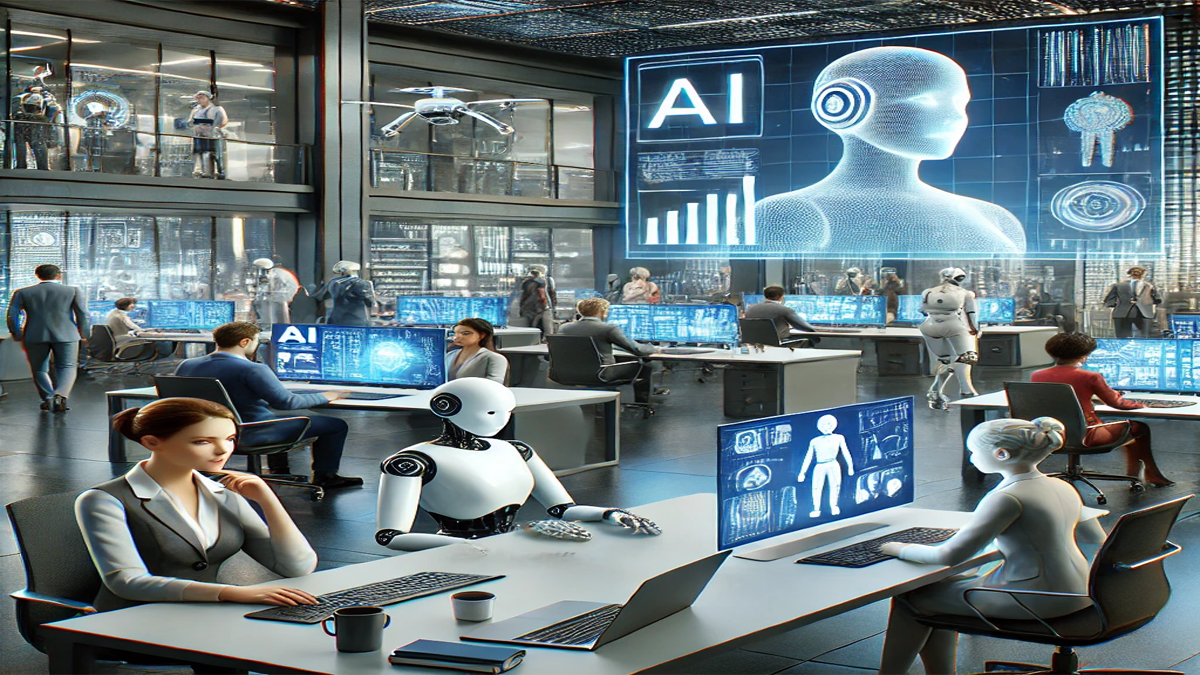


Artificial Intelligence (AI) is no longer a futuristic concept—it’s transforming workplaces globally. From automation to decision-making, AI is revolutionizing industries, creating new opportunities, and challenging traditional job roles. This comprehensive guide explores how AI is rewriting the future of work, its benefits, challenges, and how professionals can adapt.
A. How AI is Changing Job Roles
AI’s impact varies across sectors, but its influence is undeniable.
- Automation of Repetitive Tasks
- AI handles data entry, customer service chatbots, and invoice processing.
- Frees employees for strategic, creative tasks.
- Enhanced Decision-Making
- AI analyzes big data to predict trends and optimize operations.
- Used in finance (fraud detection), healthcare (diagnosis), and marketing (personalization).
- New AI-Driven Careers
- Prompt engineering, AI ethics consulting, and machine learning maintenance.
B. Industries Most Affected by AI
Some sectors are experiencing faster transformations than others.
- Healthcare
- AI-powered diagnostics (e.g., IBM Watson).
- Robotic surgeries and personalized treatment plans.
- Manufacturing
- Predictive maintenance reduces downtime.
- Cobots (collaborative robots) work alongside humans.
- Retail & E-Commerce
- Dynamic pricing algorithms.
- AI chatbots for 24/7 customer support.
C. Benefits of AI in the Workplace
AI adoption offers significant advantages for businesses and employees.
- Increased Productivity
- AI tools streamline workflows (e.g., Grammarly for writing, Trello for project management).
- Cost Reduction
- Automation cuts labor costs in routine tasks.
- Improved Accuracy
- AI minimizes human errors in data analysis and logistics.
D. Challenges and Ethical Concerns
Despite its potential, AI presents hurdles that need addressing.
- Job Displacement Fears
- 85 million jobs may be displaced by 2025 (World Economic Forum).
- Reskilling programs are critical for workforce transition.
- Bias in AI Algorithms
- Training data may reflect human prejudices (e.g., hiring tools favoring certain demographics).
- Data Privacy Risks
- AI systems require vast data, raising GDPR compliance issues.
E. How to Prepare for an AI-Driven Economy
Workers and businesses must adapt to stay relevant.
- Upskilling and Continuous Learning
- Learn AI tools (Python, TensorFlow) via Coursera or Udemy.
- Soft skills (creativity, emotional intelligence) remain irreplaceable.
- Embrace Hybrid Work Models
- AI + human collaboration yields the best results.
- Advocate for Ethical AI Policies
- Support regulations ensuring transparency and fairness.
F. The Role of Governments and Organizations
Policy and corporate responsibility shape AI’s integration.
- Investing in AI Education
- Finland’s “AI Challenge” trains 1% of its population in AI basics.
- Subsidizing Reskilling Programs
- Singapore’s SkillsFuture initiative funds worker training.
- Global AI Regulations
- EU’s AI Act classifies risks and sets usage boundaries.
G. Future Predictions: What’s Next?
AI’s evolution will further redefine work dynamics.
- AI as a Co-Worker
- More industries will adopt AI assistants for real-time support.
- Decentralized Workforces
- Remote work + AI tools enable borderless teams.
- Human-AI Symbiosis
- Focus shifts to uniquely human skills (innovation, empathy).
Conclusion
AI is not just changing jobs—it’s redefining how we work. While challenges like job displacement exist, proactive adaptation through education and ethical policies can harness AI’s potential. The future belongs to those who embrace AI as a collaborator, not a competitor.
Tags: AI in workplace, future of work, automation, AI jobs, machine learning, reskilling, ethical AI, digital transformation, AI economy, workforce trends