



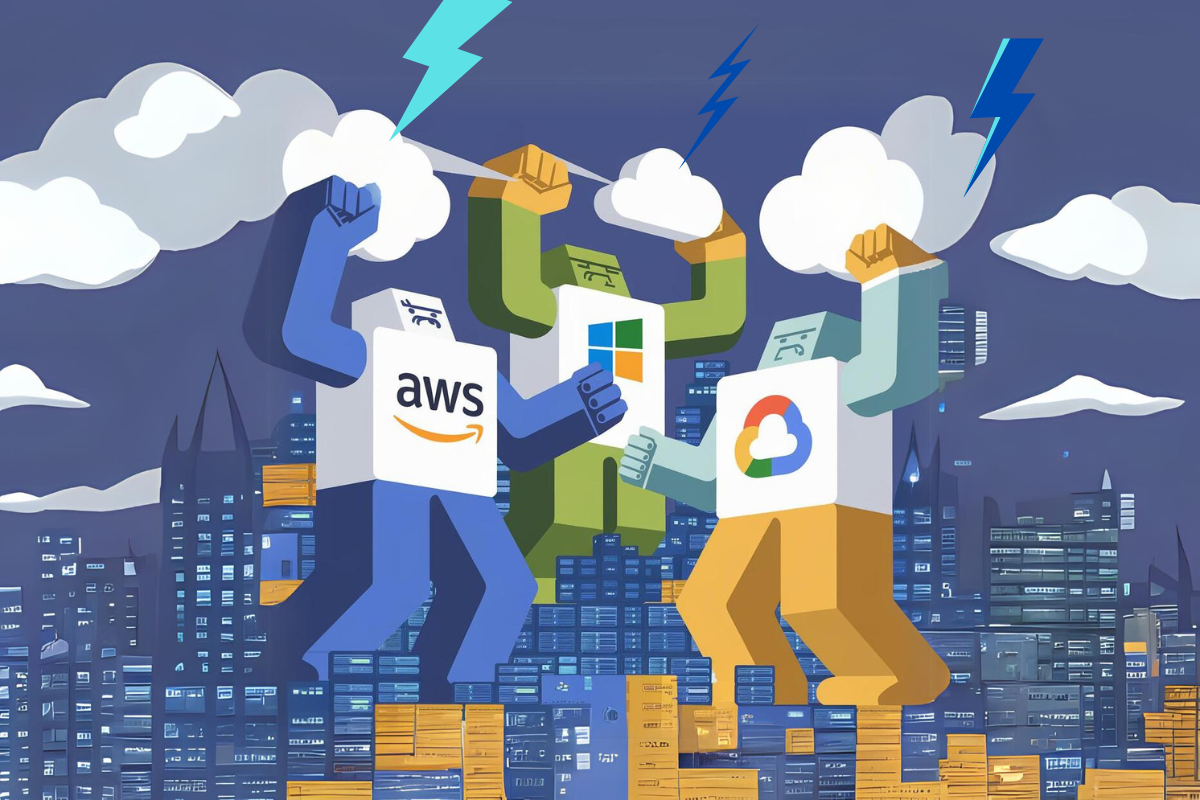

The cloud computing industry is experiencing unprecedented competition as tech giants battle for dominance. With digital transformation accelerating globally, companies like Amazon, Microsoft, and Google are investing billions to expand their cloud infrastructure, AI capabilities, and market share. This article explores the intensifying “Cloud Wars,” analyzing the key players, emerging trends, and what the future holds for businesses and consumers.
A. The Major Players in the Cloud Computing Battle
The cloud market is dominated by a few powerful competitors, each with unique strengths:
-
Amazon Web Services (AWS) – The current market leader, holding ~33% share. Strengths include scalability, global infrastructure, and a vast service catalog.
-
Microsoft Azure – Rapidly growing due to enterprise integrations (Office 365, Windows Server) and hybrid cloud solutions.
-
Google Cloud Platform (GCP) – Differentiates with AI/ML tools, data analytics, and strong Kubernetes support.
-
Alibaba Cloud – The dominant force in Asia, expanding globally with competitive pricing.
-
IBM Cloud & Oracle Cloud – Focus on niche markets like legacy enterprise and high-performance databases.
B. Why the Cloud Wars Are Intensifying in 2024
Several factors are fueling the competition:
-
AI & Machine Learning Integration – Cloud providers are embedding AI into their platforms (e.g., AWS Bedrock, Azure OpenAI, Google Vertex AI).
-
Hybrid & Multi-Cloud Adoption – Businesses demand flexibility, pushing providers to improve interoperability.
-
Edge Computing Growth – Faster data processing requires decentralized cloud infrastructure.
-
Price Wars & Discounts – AWS, Azure, and GCP aggressively cut prices to attract startups and enterprises.

C. Key Strategies Each Player is Using to Dominate
1. Amazon Web Services (AWS)
-
Expanding Global Data Centers – New regions in emerging markets.
-
AI & Serverless Focus – Lambda, SageMaker, and Bedrock attract developers.
-
Partnerships with Enterprises – Long-term contracts with major corporations.
2. Microsoft Azure
-
Leveraging Enterprise Relationships – Deep integration with Windows, Active Directory, and SQL Server.
-
Hybrid Cloud Solutions – Azure Arc allows seamless on-premises and cloud management.
-
AI & GitHub Synergy – Copilot and OpenAI integrations attract developers.
3. Google Cloud Platform (GCP)
-
AI & Data Analytics Leadership – BigQuery, TensorFlow, and Vertex AI set it apart.
-
Sustainability Focus – Carbon-neutral cloud infrastructure appeals to eco-conscious businesses.
-
Kubernetes & Open-Source Dominance – GKE (Google Kubernetes Engine) is an industry standard.
4. Alibaba Cloud
-
Asia-First Expansion – Stronghold in China, now targeting Southeast Asia and Europe.
-
Cost-Effective Solutions – Competitive pricing undercuts AWS and Azure.
-
E-Commerce Integration – Seamless support for Alibaba’s ecosystem.
D. Emerging Trends Shaping the Future of Cloud Wars
-
AI-First Cloud Platforms – Generative AI tools (like ChatGPT) require massive cloud computing power.
-
Quantum Computing in the Cloud – AWS Braket, Azure Quantum, and Google’s Quantum AI are pioneering this space.
-
Serverless & Low-Code Adoption – Faster deployment reduces costs for businesses.
-
Increased Cybersecurity Investments – Zero-trust security models are becoming standard.
-
Industry-Specific Cloud Solutions – Healthcare, finance, and gaming clouds are growing.

E. How Businesses Should Navigate the Cloud Wars
-
Evaluate Cost vs. Performance – Compare pricing models (pay-as-you-go vs. reserved instances).
-
Consider Multi-Cloud Strategies – Avoid vendor lock-in by using multiple providers.
-
Prioritize Security & Compliance – Ensure GDPR, HIPAA, or regional data laws are followed.
-
Leverage AI & Automation – Use built-in cloud AI tools for efficiency.
-
Monitor Emerging Technologies – Edge computing and quantum-ready clouds may offer future advantages.
F. Predictions for the Next Phase of Cloud Wars
-
Consolidation & Acquisitions – Smaller players may be acquired by AWS, Azure, or Google.
-
More AI-Driven Cloud Services – Expect deeper AI integration across all platforms.
-
Increased Government Regulation – Data sovereignty laws could impact global cloud expansion.
-
Sustainability as a Competitive Edge – Green data centers will attract eco-conscious clients.
Conclusion
The Cloud Wars show no signs of slowing down, with AI, hybrid cloud, and security being key battlegrounds. Businesses must stay informed to choose the best cloud provider while leveraging cost-efficiency, innovation, and scalability. As competition intensifies, the winners will be those who adapt fastest to technological advancements.
Tags: Cloud computing, AWS vs Azure, Google Cloud, AI in cloud, hybrid cloud, multi-cloud strategy, edge computing, cloud security, serverless computing, quantum cloud